
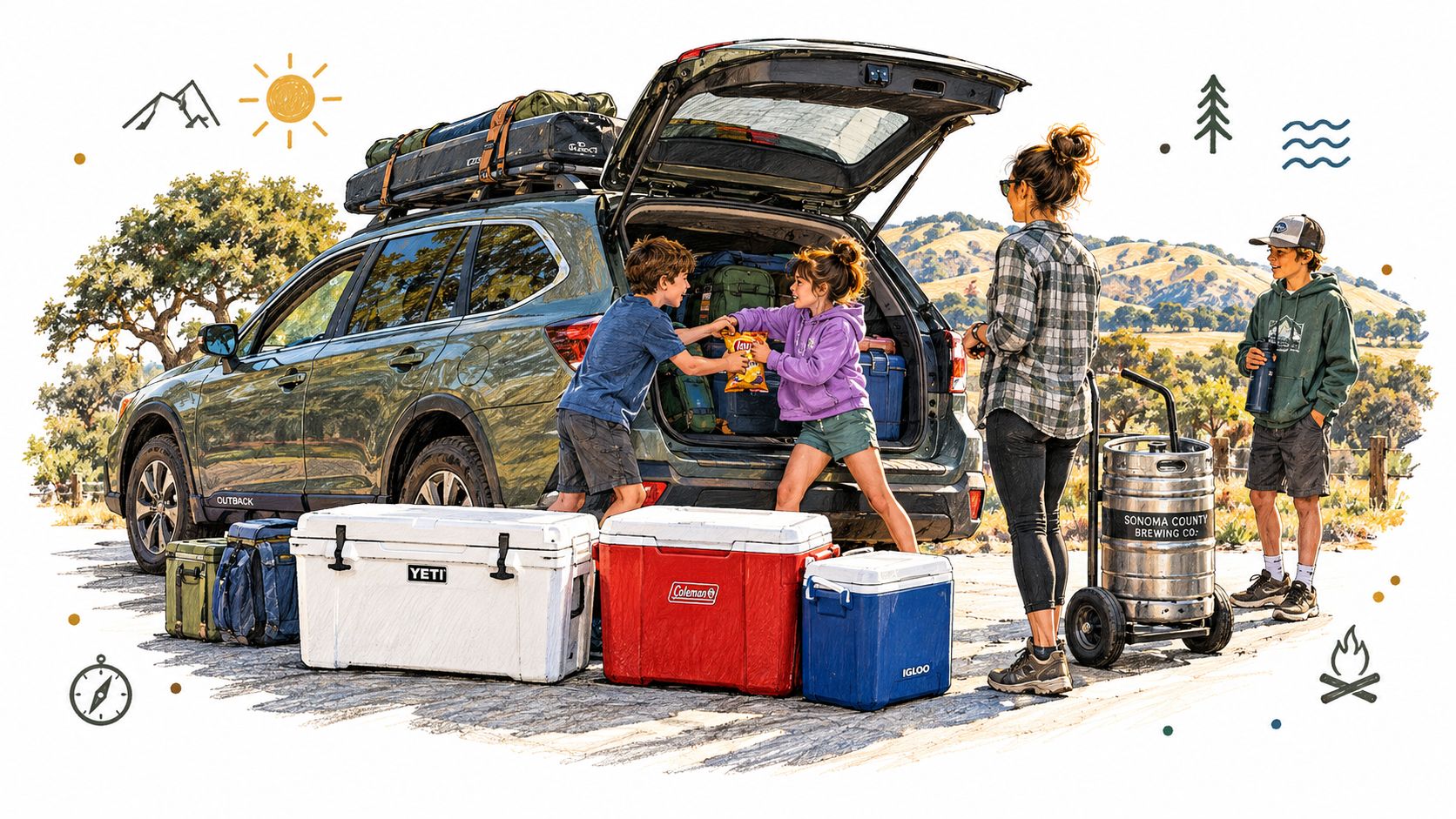
You're standing in a Santa Rosa driveway with a loaded Subaru, a warm Saturday already getting away from you, and three coolers competing for space beside the hatch. The kids are arguing over snacks, Sebastopol produce is packed into bags, and a keg of local beer is destined for Tahoe. The practical question isn't which cooler looks toughest online. It's whether your ice, food, and patience will survive the drive and the weekend.
I've hauled coolers from Sonoma County to Tahoe, Santa Cruz, the Sonoma Coast, and back again. My advice is simple: buy for the trip you take, not the expedition you imagine. A compact soft cooler is right for a Healdsburg picnic, a mid-size hard cooler handles a Santa Cruz overnight, and a large rotomolded model earns its space on a family car-camping trip.
| Cooler type | Best use | Main advantage | Main trade-off |
|---|---|---|---|
| Rotomolded hard cooler | Tahoe weekends and multi-day camping | Strong insulation and rugged construction | Heavy and expensive |
| Traditional hard-shell cooler | Beach days and casual overnights | Affordable and easy to replace | Weaker retention |
| Soft-sided cooler | Short hikes, picnics, and day trips | Light and portable | Limited multi-day performance |
The global camping coolers market was estimated at USD 893.7 million in 2022 and is projected to reach USD 1,207.9 million by 2030, according to Grand View Research's camping cooler market analysis. That growth reflects how far the category has moved beyond a basic ice chest. By the end of this guide, you'll know which capacity, construction, and price tier belongs in your garage.
Starting in Sonoma with the Right Cooler for the Drive Ahead
A Santa Rosa departure exposes cooler mistakes quickly. The car is full before the first bag goes in, the kids want cold drinks within minutes, and every stop adds another reason to open the lid. A cooler that performs beautifully in a controlled test can struggle when it's wedged beside camping bins, sitting in sunlight, and opened repeatedly before you've reached the Sierra.
Start with trip length. For a single day at Armstrong Redwoods or Goat Rock, you don't need a heavy 65-quart tank. A compact hard cooler or soft-sided model carries lunch, fruit, drinks, and a few ice packs without taking over the vehicle.
Choose the capacity before the logo
An overnight at Salt Point or a beach stay near Santa Cruz calls for more insulation and room for separate food and drinks. A mid-size hard cooler becomes useful here. It gives you enough cold storage for the drive, dinner, breakfast, and the return trip without the bulk of a family-size box.
A Russian River car camp is different. Families need space for produce, dairy, prepared meals, snacks, and drinks, while the cooler may serve as a seat or camp table. For that job, choose a large model with dependable handles or wheels. The market data supports that preference: the 50- to 75-quart range led with 38.64% of revenue, and hard coolers held 62.81% of market share in 2025, as reported by Grand View Research. Those figures fit what I see at Northern California campsites, where durability and capacity usually matter more than carrying an empty cooler with one hand.
Practical rule: If you'll carry the cooler farther than you can comfortably carry a loaded grocery bag, buy wheels or downsize.
The build matters as much as the volume. Rotomolded walls and a tight gasket make sense for a Sonoma-to-Tahoe weekend. A traditional hard-shell cooler is often the smarter value for a beach day, especially if you'll drag it across sand. A soft cooler wins when storage space and portability matter more than multi-day retention.
That's the decision framework I use: day trip, choose portable; overnight, choose balanced; multi-day family camp, choose insulated capacity. Don't pay for bear-resistant hardware, thick walls, or oversized volume unless your trips justify them.
Cooler Types Worth Knowing Before You Buy
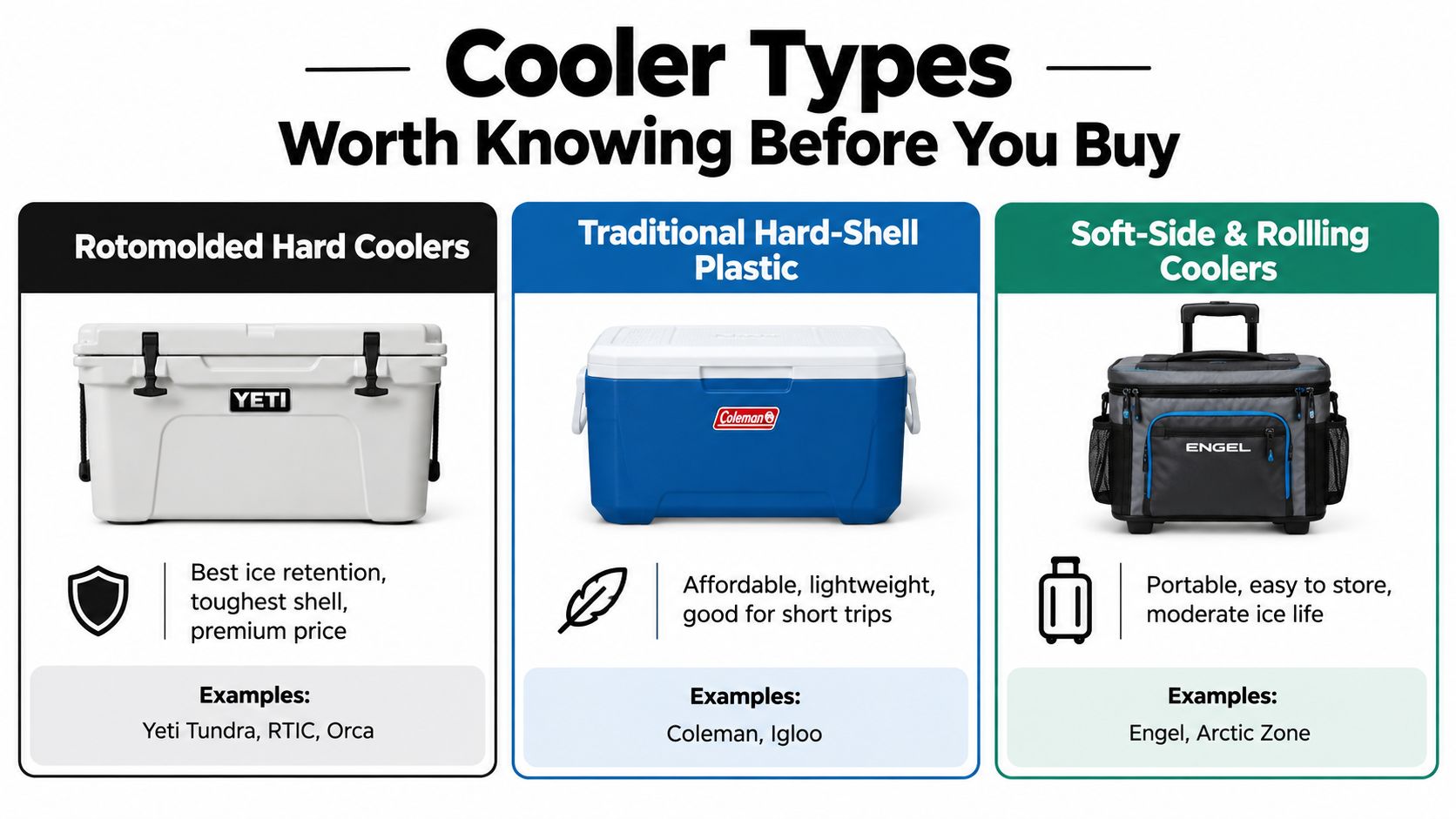
Three cooler categories cover almost every Sonoma County camping use case.
Rotomolded hard coolers are the serious option. The manufacturing process creates a thick, uniform, one-piece shell, usually paired with substantial insulation. Yeti Tundra, RTIC, and Orca models belong here. They're tough enough for truck beds, boat decks, rough roads, and repeated campsite abuse. The price is weight. An empty rotomolded cooler already feels substantial, and loading it with food and ice can turn a short carry into a two-person job.
The history explains why these coolers feel overbuilt. Rotational molding dates to the 1850s, while polyethylene powders made the process practical for cooler-style plastic products in the 1950s and 1960s, according to Boright's history of rotomolded coolers. Thick walls, consistent construction, and durable shells later became central to premium cooler design.
Traditional plastic still has a place
Coleman and Igloo hard-shell coolers use lighter, less expensive construction. They're ideal for a Santa Cruz beach day, a Sonoma Coast picnic, or an overnight where you can buy more ice nearby. Their thinner walls generally give up retention to rotomolded models, but that compromise often makes sense if the cooler spends most of its life in the garage.
Wheels are valuable on sand and paved campground paths. They're less helpful on rocky trails, loose gravel, or steep access routes. Check the wheel diameter, handle lock, and drain location before buying. A cooler that rolls well across a parking lot may still be awkward at a primitive campsite.
Soft-sided coolers favor movement
Soft coolers such as the Yeti Hopper, RTIC Softpak, and AO Coolers are the easiest to carry and store. They work well for short hops to Healdsburg wineries, a hike to a picnic spot, or a day at the coast. Many use welded seams, padded straps, and zippered lids, but they don't provide the rigid protection or long retention of a well-built hard cooler.
Pay attention to the closure. A soft cooler needs a reliable zipper or roll-top seal. A hard cooler needs a gasket that sits evenly, latches that don't loosen, and a drain plug you can operate without tools. For Sierra and Trinity trips, also check whether the model is lockable and whether it has recognized bear-resistance certification. A lockable lid alone isn't the same as certified bear resistance.
For entertaining at home or serving a large group, a premium ice chest for entertaining can make more sense than a portable camping design. For actual travel, I'd choose rotomolded for multi-day Tahoe trips, traditional plastic for affordable day use, and soft-sided for short, mobile outings.
Comparing Top Coolers for Capacity, Ice Retention, and Price
For a Sonoma to Tahoe drive, capacity matters less than how the cooler fits your group, vehicle, and campsite routine. The table below uses verified figures where the article has them and marks unavailable details with an em dash. Prices remain relative because they change by model and retailer.
Camping Cooler Comparison for Sonoma County Trips
| Cooler Model | Capacity (qt) | Empty Weight | Tested Ice Retention | Approx. Price | Best Sonoma County Trip |
|---|---|---|---|---|---|
| Yeti Tundra 45 | 45 | , | , | Premium | Santa Cruz overnight or small-group Tahoe trip |
| Yeti Tundra 65 | 65 | , | , | Premium | Family Russian River camp or Tahoe weekend |
| RTIC 45 | 45 | , | , | Mid-to-premium | Weekend car camping |
| RTIC 65 | 65 | , | About 5.4 to 5.5 days | Mid-to-premium | Larger family trips |
| Orca 40 | 40 | , | , | Premium | Overnight coast trip |
| Coleman Xtreme 50 | 50 | , | , | Budget | Day trips and casual overnights |
| Igloo Trailmate | 50 | , | , | Budget | Beach access and rolling campground paths |
| Yeti Hopper M20 | Not applicable to a rigid quart comparison | , | Trails hard coolers in testing | Premium soft-side | Hikes, picnics, and short outings |
The clearest performance anchors come from independent testing. Premium rotomolded coolers can stay below 40°F for roughly 5 to 7 days. The Yeti Roadie 48 reached 6.8 days, while the RTIC 65 reached about 5.4 to 5.5 days. The Coleman Classic Series 52 reached 40°F in about 4.0 days, according to OutdoorGearLab's cooler testing.
Those results matter on a Tahoe weekend, where replacing ice can mean leaving camp for a mountain-town store. They matter less during a Santa Cruz beach day or a Goat Rock outing, where carrying the cooler from the car to the sand is the bigger concern. For family car camping, the 65-quart class gives you more room for food and drinks, but the extra bulk can make loading and unloading harder.
My buying bias: Spend more on insulation only when it prevents a real problem, such as spoiled food or an unnecessary mountain-town ice run.
A budget hard cooler handles a day or overnight trip well when you pre-chill it, pack it tightly, and keep it shaded. It is the sensible choice for casual Russian River camping and short Sonoma County drives. A premium rotomolded cooler earns its cost through stronger construction, a better seal, and more consistent performance across repeated Tahoe trips.
Soft-sided models serve a different purpose. The Yeti Hopper M20 is easier to carry to a picnic, trailhead, or beach, but it gives up the rigid storage and longer ice life of a hard cooler. Choose it for mobility. Choose a hard cooler when food storage and multi-day use come first.
How Real Campsite Conditions Change Ice Retention
Lab numbers are useful for comparing models, but they're poor trip planners by themselves. Manufacturers typically assume a pre-chilled cooler packed full, kept closed, and protected from direct sun. Actual camping often means warm food, empty space, an open lid while someone searches for mustard, and a cooler sitting on hot vehicle flooring.
Northern California adds its own complications. A cooler in the shade at a cool coastal campground has a much easier job than one on a black truck bed near the Russian River. Sand can insulate poorly and make the cooler awkward to move. At Tahoe, elevation and strong sun can make a mild air temperature feel deceptively harsh on exposed gear.
The variables that matter most
Opening frequency is the first practical penalty. Every opening replaces cold air with warmer air, and searching through a crowded cooler keeps the lid open longer. Separate drinks from food when possible, so a frequently accessed beverage cooler doesn't sacrifice the food supply.
Sun exposure is another major hit. A light-colored cooler generally absorbs less heat than a dark one, but shade still wins. Put the cooler under a picnic table, inside a vehicle only when safe and ventilated, or beneath a reflective cover that doesn't block airflow.
Packing density also changes results. A full cooler holds temperature more efficiently than one with large pockets of warm air, but overpacking makes food difficult to find. Block ice lasts longer than small cubes because larger pieces expose less surface area to warm air.
Lab claims versus a usable plan
| Condition | Lab Claim (Hours) | Realistic Performance (Hours) | Main Factor |
|---|---|---|---|
| Premium rotomolded hard cooler | Roughly 120 to 168 | Plan around a shorter window in active camp use | Openings, sun, and partial loads |
| Yeti Roadie 48 in independent testing | About 163 | Treat the result as a controlled benchmark | Test conditions differ from camp |
| RTIC 65 in independent testing | About 130 to 132 | Expect less with warm contents and frequent access | Packing and heat |
| Coleman Classic Series 52 in independent testing | About 96 | Use as a short-trip reference | Lighter construction |
| REI Co-op Trail Gate soft cooler | 156 in a 2026 test | Plan conservatively for day and overnight use | Soft construction and access pattern |
| Titan PRO High Performance Welded | 120 in a 2026 test | Suitable for shorter trips | Conditions and packing |
| Yeti Hopper Flip | 72 in a 2026 test | Best treated as a day-use cooler | Soft-side format |
The soft-cooler figures come from GearJunkie's independent soft-cooler testing. Their spread, from 72 to 156 hours, shows why a brand's reputation can't replace model-specific testing.
I plan for the campsite, not the chart. If your trip runs from Santa Rosa to Bodega Dunes or Sugar Loaf, pack as though the cooler will work hard. Pre-chill it, load cold food, keep it shaded, and assume you'll lose retention whenever the group treats the lid like a refrigerator door.
Matching Coolers to Sonoma County Day Trips and Weekend Getaways
The best camping cooler changes with the road. A cooler that feels perfectly reasonable at Goat Rock becomes unnecessary cargo on a short hike, while the same model may feel undersized once four people need three days of food.
Goat Rock is a compact-cooler assignment
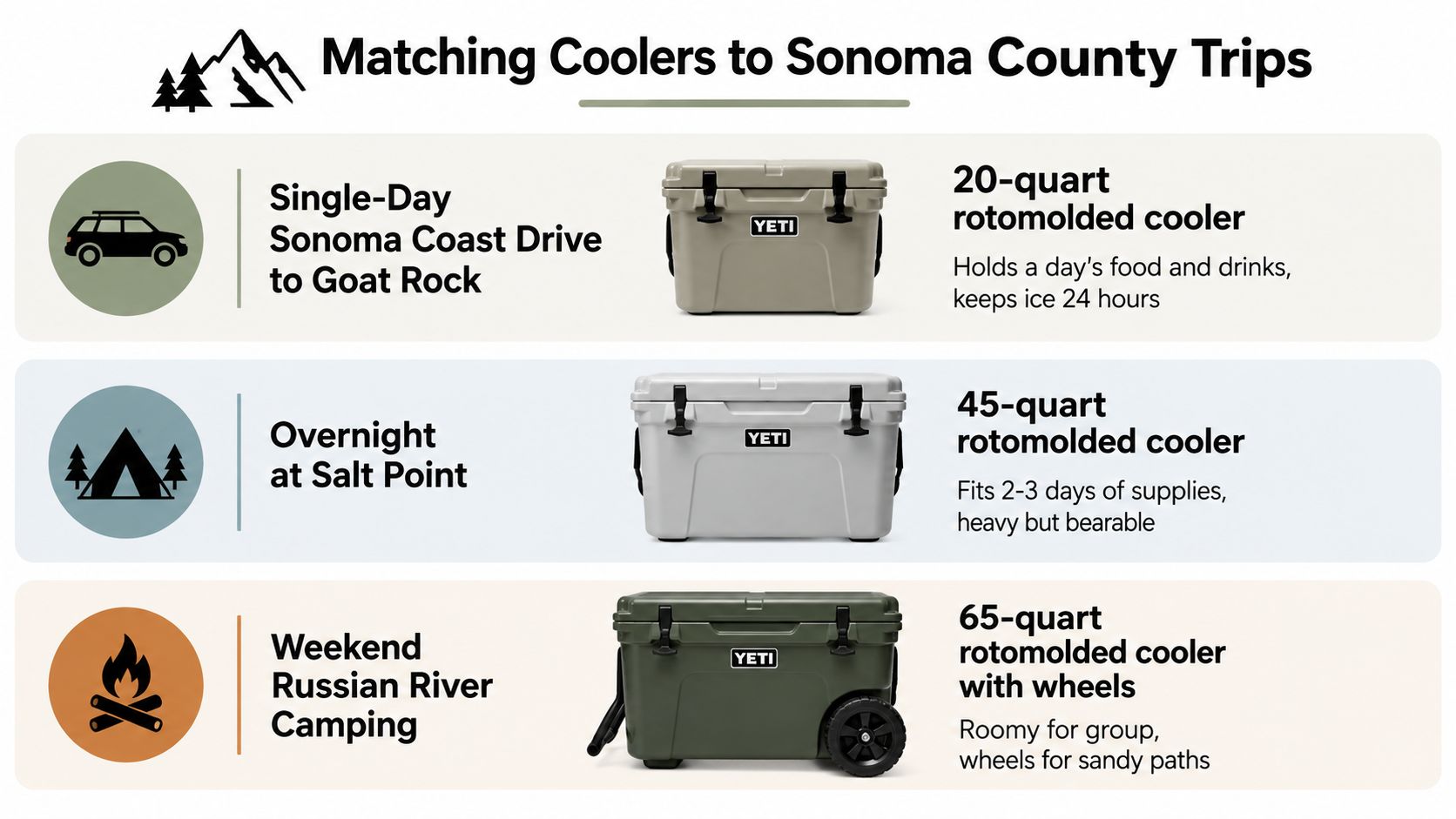
For a single-day Sonoma Coast drive from Santa Rosa to Goat Rock, I'd take a 20-quart hard cooler or a well-insulated soft cooler. Pack breakfast, lunch, fruit, water, and a modest amount of ice. A rotomolded compact model is excellent if you already own one, but buying a premium tank specifically for this outing is unnecessary.
The beach changes the calculation. Wheels may help across a parking area but often become frustrating in sand. A carry handle and manageable loaded weight are more useful.
Salt Point rewards a mid-size build
For an overnight at Salt Point, step up to roughly a 45-quart rotomolded cooler if your vehicle has room. It gives a couple or small group enough space for dinner, breakfast, snacks, drinks, and a serious ice load. The heavier shell is worthwhile when you don't want to depend on a quick refill.
For campground planning and nearby outdoor options, use this Sonoma County camping spots guide before choosing your cooler. The access route matters as much as the campsite.
Russian River and Santa Cruz need different compromises
A family car camp along the Russian River calls for a 65-quart cooler with wheels, particularly when the path from vehicle to site is sandy or uneven. That size supports group food and drinks, but it becomes awkward when fully loaded, so recruit a second person rather than pretending the cooler is light.
A four-person Santa Cruz beach day sits between those use cases. I'd choose a traditional hard-shell cooler with wheels, or a mid-size rotomolded model if you'll keep it for years. You need capacity for drinks and lunch, but not necessarily multi-day insulation.
| Trip | My pick | Why |
|---|---|---|
| Goat Rock day drive | Compact hard or soft cooler | Easy carry and enough room for one day |
| Salt Point overnight | 45-quart rotomolded cooler | Balanced capacity and retention |
| Russian River family camp | 65-quart wheeled hard cooler | Group capacity and easier movement |
| Santa Cruz beach day | Traditional wheeled hard cooler | Better value for sand and short use |
| Sonoma-to-Tahoe weekend | Mid-size or 65-quart rotomolded cooler | More dependable cold storage for a longer run |
For Tahoe, compare a Yeti Tundra 65 with a smaller Roamer 24 only after counting the crew's meals and drinks. The 65 is the better group tool, but the smaller option wins when you're traveling light, buying food near camp, or carrying the cooler without help.
Packing and Usage Tips That Actually Extend Ice Life
A premium cooler won't rescue careless packing. The night before departure, bring the cooler indoors, clean and dry it, and add sacrificial ice to pull down the interior temperature. Drain that ice before loading fresh ice and already-cold food.
Use frozen water bottles when you want cold storage without loose meltwater. For longer trips, combine them with block ice. Small cubes cool quickly, but large blocks generally last longer because they expose less surface area to warm air.
Build the load around access
Put items you won't need immediately at the bottom, then create layers that keep food organized. I prefer sealed proteins low in the cooler, produce and prepared food in the middle, and drinks near the top. Keep raw meat sealed separately so leaks don't contaminate other food or meltwater.
Cover the top layer with ice. Cold air falls when the lid opens, so a solid ice layer helps replace the warmth that enters from above. Fill gaps with towels or crumpled newspaper, but don't pack so tightly that you can't close the lid evenly.
The two-to-one rule: For a Sonoma summer trip, start with roughly two parts ice to one part contents, then adjust for your cooler and access pattern.
Shade is free insulation. Keep the cooler off a black truck bed, rotate it so the lid faces away from direct sun, and cover it with a light-colored or reflective blanket while leaving the drain and lid accessible. Don't put hot food or warm drinks inside and expect thick walls to erase that heat.
Before leaving, check the gasket, drain plug, latches, and tie-down points. Pack drinks in a separate small cooler if the group will open them constantly. For coastal camping details and access planning, review this Doran Beach camping guide.
The practical checklist is short:
- Pre-chill: Add sacrificial ice, drain it, and reload.
- Freeze ahead: Use frozen bottles and block ice.
- Pack cold: Chill food and drinks before they enter the cooler.
- Close decisively: Take out several items at once.
- Protect from heat: Keep the cooler shaded and off hot surfaces.
The video below demonstrates the packing approach in action.
Final Picks for the Best Camping Cooler in Your Garage
For a Sonoma County camper, a mid-size rotomolded cooler is the best default. It handles Santa Rosa-to-Tahoe weekends, Bodega Bay overnights, and family camps without the bulk of the largest models. You'll carry more and pay more than you would for a basic Coleman or Igloo, but the stronger build and longer useful life make the upgrade worthwhile.
The Yeti Tundra 45 and RTIC 45 are the sensible middle ground. Choose the Yeti for its proven hardware, strong gasket, and polished long-term construction. Choose the RTIC for similar rotomolded practicality at a lower price tier.
Best picks by trip and budget
| Pick | Best For | Capacity | Ice Retention | Price Tier |
|---|---|---|---|---|
| Yeti Tundra 45 | Best overall for small groups | 45 qt | Strong multi-day performance in testing | Premium |
| Coleman Xtreme 50 | Best budget hard cooler | 50 qt | About 4 days to reach 40°F in testing | Budget |
| Yeti Tundra 65 | Best premium Tahoe upgrade | 65 qt | Among the strongest hard-cooler results | Premium |
| Wheeled 65-quart hard cooler | Best family Russian River camping | 65 qt | Depends on model and conditions | Mid-to-premium |
| Yeti Hopper M20 | Best soft cooler | Soft-sided | Soft coolers trail hard coolers overall | Premium soft-side |
| Compact 20-quart hard cooler | Best solo day use | About 20 qt | Adequate for a day when packed well | Budget-to-premium |
The Coleman Classic Series 52 is my budget recommendation for day outings and accessible overnights. It gives up some ice life to premium rotomolded models, but that trade-off makes sense when you are driving to a nearby campsite, spending the day at Santa Cruz, or returning home the next morning. The lower cost also leaves room in the budget for better ice and food storage.
For multi-day Sierra camping, step up to the Yeti Tundra 65 or RTIC 65. Hard rotomolded coolers generally outperform wheeled and soft formats in controlled testing, while models such as the YETI Tundra 45, Roadie 24 2.0, and RTIC Ultra-Light have performed strongly, according to GearJunkie's cooler guide.
My final decision rule is direct:
- One day: Buy compact and light.
- One overnight: Choose a traditional hard cooler or mid-size rotomolded model.
- Two or three days: Buy the mid-size rotomolded option.
- Family camping: Choose 65 quarts and wheels if the terrain allows.
- Frequent hiking: Use a soft cooler and accept the shorter ice life.
- Sierra or bear country: Prioritize secure closures and verify certification for the exact model.
A 65-quart cooler earns its place when your group, food plan, and route require it. Otherwise, the smaller model is easier to load, carry, and keep cold.
Match cooler size to trip length, group size, food plan, and campsite access instead of buying the largest model you can fit in the garage.
Sign up for Sonoma County Navigator
Discover Sonoma County! Latest News, places to play, stay, eat, live, shop, learn and more!
No spam. Unsubscribe anytime.