

You're probably making the same three decisions every Sonoma County paddler makes before a Bodega Bay kayak day. How long the drive will really take, where to launch, and whether the tide window lines up with your actual arrival.
That sounds simple until you're loading the car in Santa Rosa, coffee in one hand, PFDs in the back, and trying to decide whether a relaxed harbor paddle is still realistic if traffic stacks up on the coast. Bodega Bay is close enough to be an easy day trip from Sonoma County, but it's also exposed enough that timing matters. The harbor can feel forgiving at one hour and pushy the next.
Bodega Harbor has a long paddling and maritime history, and Sonoma County Parks identifies it as one of the county's popular paddling locations. It's also one of the closest major kayak destinations for Sonoma County visitors, typically about 1 to 1.5 hours from Santa Rosa depending on route and traffic, which is a big reason so many local paddlers keep coming back to it (Sonoma County Parks boating and paddling overview).
Driving from Sonoma County to the Water
A Bodega Bay kayak day usually gets decided before the boats touch water. You load up in Santa Rosa or Petaluma, check the sky, and make the first real call of the day. Leave early enough to keep your launch options open, or leave later and accept whatever parking, wind, and ramp traffic are waiting when you arrive.
For Sonoma County paddlers, the drive is part of trip planning, not dead time. Santa Rosa drivers usually run west through Sebastopol and Bodega. South county drivers often have to choose between a more direct inland approach and a route that reconnects with Highway 1 farther north. Either way, the last stretch slows people down. Farm equipment, weekend beach traffic, and fog can all stretch a simple coastal drive into a missed launch window.
The practical point is simple. Pick your launch before you leave home, then build your departure time around that access point.
| Starting Town | Likely Approach | Main Delay Risk | Planning Note |
|---|---|---|---|
| Santa Rosa | West through Sebastopol toward Bodega, then Highway 1 | Traffic building near the coast | Easiest county start for a dawn harbor launch |
| Petaluma | North and west via inland connectors, or up first before turning west | More route variability from south county | Decide route before departure, not at the last stoplight |
| Sebastopol | Straight westbound approach | Late slowdowns close to the coast | Shorter drive, but easy to give back time near the end |
| Sonoma Valley towns | Longer inland approach before the coast turn | Traffic sensitivity across multiple segments | Leave more margin than you think you need |
That route decision matters because each launch area around Bodega Harbor works differently.
If the plan is Doran Regional Park, 201 Doran Beach Rd, Bodega Bay, CA 94923, the key variable is gate access and parking turnover. Sonoma County Regional Parks notes that lots can fill on warm weekends and holidays, and visitors may be turned away, especially later in the morning (Doran Beach summer operations and safety notes). For paddlers, that means Doran is a better target when you want predictable parking and an easier unload. Early arrival gives you more room to choose a carry path and sort gear without rushing.
If the plan is Westside Regional Park and boat launch, 2400 Westshore Rd, Bodega Bay, CA 94923, the trade-off is different. The access is convenient for harbor launches, but the parking lot and ramp area can get busy with trailered boats, anglers, and commercial harbor traffic. A late arrival there can still get you on the water, but the put-in is less forgiving if you're reorganizing dry bags in the lane or trying to decide where to stage your kayak after you park.
I treat those two launch zones as two different mornings. Doran rewards the early family or casual harbor paddle. Westside suits paddlers who already know their route and want efficient harbor access.
A few habits save trouble:
- Fuel up and buy food inland. Every extra stop after Bodega costs time you may want for unloading, parking, or switching launch sites.
- Download offline maps before leaving town. Cell service can drop along the coast, and some turnoffs are easier to miss than they should be in fog.
- Text your group the exact launch address. “Bodega Bay” is not specific enough when half the party is aiming for Doran and the other half is circling Westside.
- Bring a cart only if your launch needs it. At some access points it helps. At others it is one more thing to wrestle in a tight lot.
Sonoma County Parks lists Bodega Bay among the county's established paddling destinations, which fits what local paddlers already know. It is close enough for a day trip, but exposed enough that a casual departure can turn into a compromised launch plan (Sonoma County Parks boating and paddling overview).
If you are comparing this outing with another Northern California coastal paddle, this Half Moon Bay kayaking guide gives a useful contrast in access and day-of logistics.
The best Bodega Bay arrivals feel almost boring. You know which lot you are driving into, what the carry looks like, and how much time you still have to change plans if the harbor looks different than expected.
Reading the Tides, Wind, and Fog at Bodega Bay
Leave Santa Rosa under blue sky and you can still arrive to a gray harbor, a stiff breeze, and water moving harder than it looked on your weather app. That gap between inland conditions and what is happening at Bodega Harbor is what changes a simple paddle into a short, conservative outing, or a cancellation.
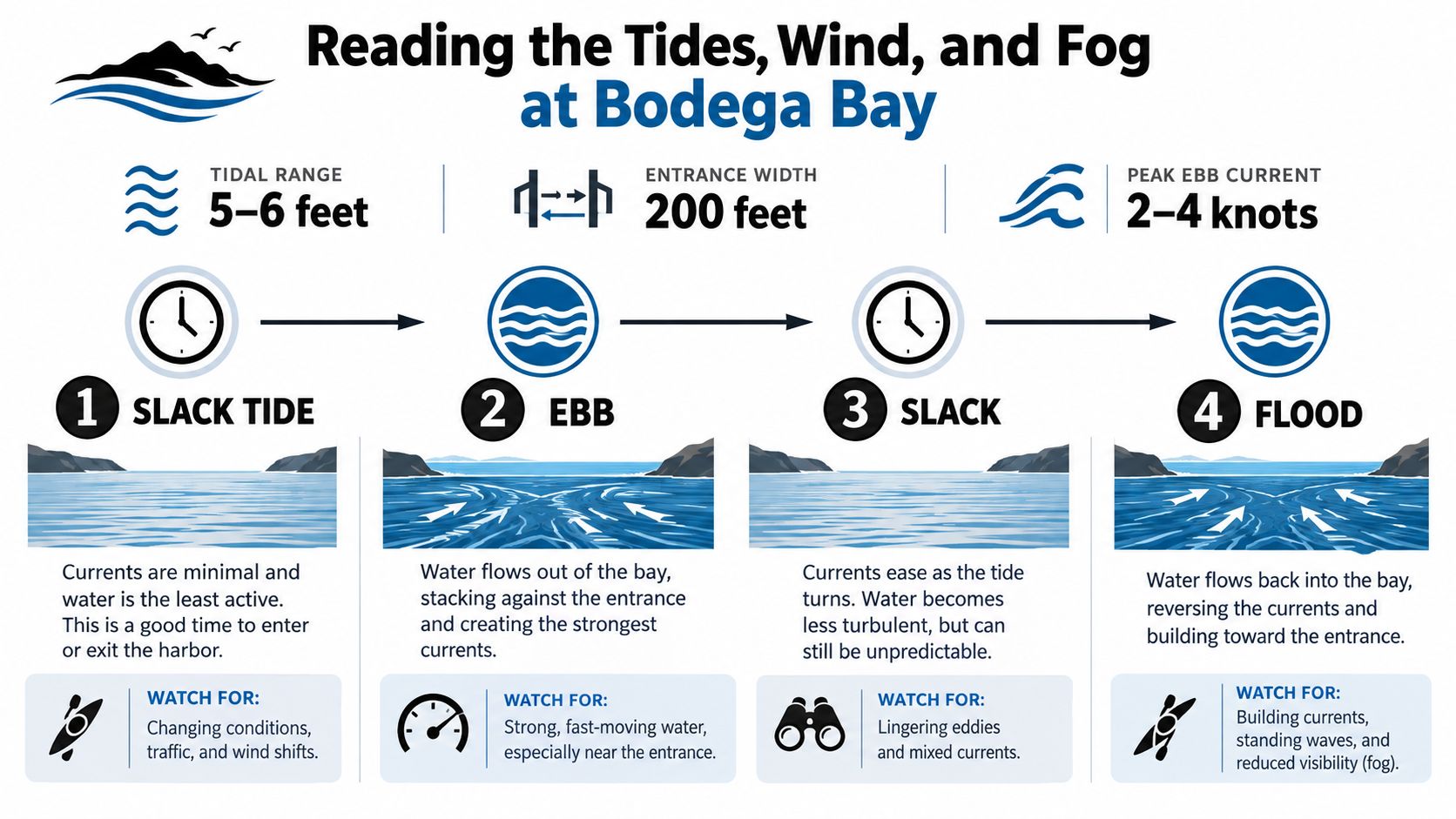
The entrance sets the tone. Inside the harbor, the water can feel forgiving. Closer to the mouth, the tidal exchange tightens up, the boat starts to weathercock, and a casual ferry angle stops being enough. If your plan includes getting anywhere near the dog-leg or entrance, timing matters as much as boat choice.
What the entrance does to your boat
A lot of paddlers read the harbor from shore and underestimate how different it feels once the hull is in moving water. Flat surface texture does not mean slack current. You can launch into calm-looking water, paddle ten minutes toward the mouth, and find yourself spending the rest of the leg on correction strokes.
That is why local paddlers usually aim for the easiest current window if they want to poke toward the entrance. Slack gives you more margin for small mistakes, slower groups, and last-minute changes. On a route that stays well inside the harbor, you have more flexibility. Near the mouth, the tide often decides whether the outing feels controlled or busy.
Wind and fog usually make the schedule for you
Morning is often the better call. The common pattern here is lighter wind early, then more chop and more work later in the day. A route that feels casual at 8 a.m. can turn into a grind by late morning if the breeze fills in across the harbor.
Fog is the other part of the equation. Some foggy mornings are workable if the wind stays light and you keep the route short inside the harbor. Other mornings flatten the whole shoreline into one pale backdrop, and that matters more than paddlers admit. If you cannot keep clear visual references on shore, distance gets fuzzy fast, especially for anyone who does not know the harbor well.
The trade-off is simple. Calm fog can be easier than clear sky with strong wind. Poor visibility plus building wind is where the day starts going sideways.
Wilderness Portal describes Bodega Bay as a moderate-exposure tidal waterbody, which matches what paddlers feel on the water when wind and current stack up (Wilderness Portal on Bodega Bay conditions).
A practical read before you launch
Do not make the full decision from home. Make the first decision there, then finish it in the parking lot after you look at the water.
Use this quick screen:
- If the entrance looks uneven or confused, keep the route inside the harbor or do not launch.
- If wind is already filling in while you unload, cut distance before you start.
- If fog takes away your shoreline references, stay close to shore or stay off the water.
I have had plenty of mornings at Bodega where the right move was not heroic. It was launching late into the inner harbor, or not launching at all. The good days here usually come from restraint, not ambition.
This short video is useful if you want another look at Bodega conditions before launch.
Choosing Your Launch Site on Bodega Harbor
Really have two practical public launch choices on Bodega Harbor. Doran Regional Park and Westside Regional Park. Sonoma County Regional Parks confirms that both offer wheelchair-accessible kayak launches, with Doran also providing a launch on Bodega Harbor for boats up to 20 feet (Sonoma County Regional Parks boat launches).
Doran works for the broadest range of paddlers
If you want the least stressful start, Doran is usually the cleanest answer. Sonoma County Regional Parks lists Doran Regional Park, 201 Doran Beach Road, Bodega Bay, CA 94923, with hours of 7 a.m. to sunset, a boat launch on Bodega Harbor, an ADA-accessible kayak launch, and a $4 boat launch fee for trailered boats or free for members (Doran Regional Park details).
The access mechanics are what make Doran useful. You've got a straightforward harbor setting, room to organize gear, and a put-in that suits paddlers who want to stay inside the harbor rather than flirt with the mouth. Families, first-timers, and anyone unloading a lot of gear usually have a better morning here.
There's also a logistics detail that matters if you're trailering. The park map notes that trailer parking is allowed only in yellow-highlighted areas, and the sample fee sheet shows a $4 boat launch fee plus a $7 entrance fee for a total visit cost of $11. The same document says fees are refunded if no trailer parking is available, and it lists the entrance at the Doran Ranger Station with reservations at (707) 565-2267 (Doran boat trailer map and fee example).
Westside is for a different kind of day
Westside Regional Park is the better match when your route is more about positioning near the outer harbor side than about a sheltered family launch. Its appeal is simple. You're set up closer to the part of the harbor experienced paddlers care about when they want efficient access.
That convenience comes with trade-offs. Parking can feel tighter. Loading space matters more. If the tide and wind are not aligned with your skill level, the shorter path to dynamic water isn't an advantage.
| Launch Site | Access Type | Parking | Day Fee | Best For | Limitations |
|---|---|---|---|---|---|
| Doran Regional Park | Formal harbor launch with ADA-accessible kayak launch | More straightforward for unloading, but can fill on busy days | Known launch fee for trailered boats, plus entrance structure applies in some cases | Families, beginners, harbor paddles, easy staging | Busy parking periods, fee station logistics |
| Westside Regional Park | Formal accessible kayak launch on Bodega Harbor | Narrower-feeling parking reality | Check current park rules before arrival | Experienced paddlers, quicker positioning toward outer harbor side | Less forgiving setup if conditions are already building |
| Informal marina-area put-in | Informal carry launch | Varies by day and local use | Varies | Locals traveling light | Less predictable access, less suited to first visits |
Local judgment matters more than convenience: the shortest walk to the water isn't automatically the best launch.
If you're deciding purely on what works, Doran is the safer default for most Bodega Bay kayak visitors. Westside starts making more sense when you already know why you want it.
Gear, Clothing, and Safety Essentials for the Sonoma Coast
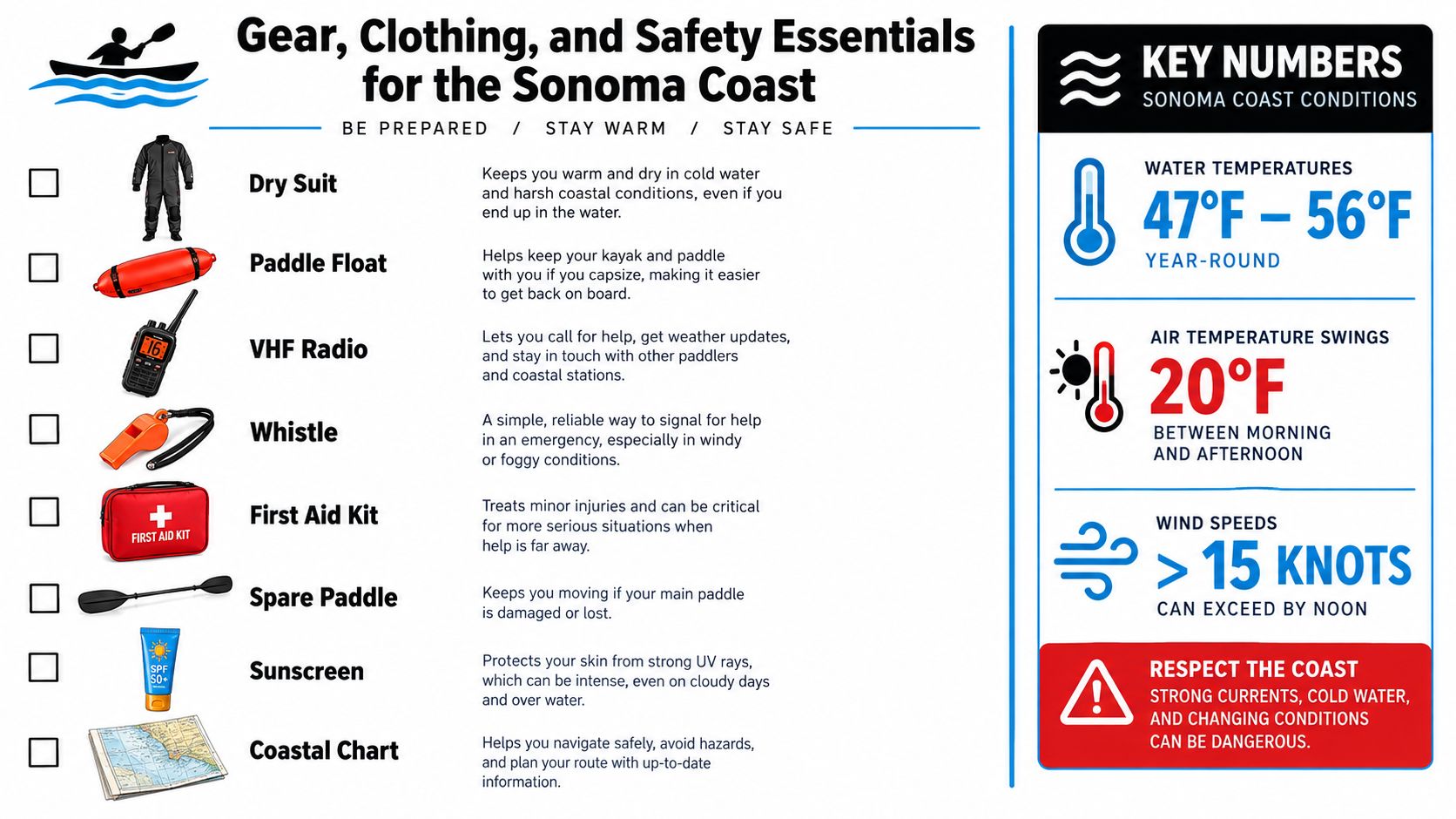
A Bodega Bay kayak day is not the place for casual warm-weather assumptions. The water stays cold enough that a simple capsize can turn into a bad situation fast, and the harbor can shift from mellow to tiring without much warning.
Dress for immersion first. Comfort comes second.
What actually earns space in the boat
A first-time Sonoma Coast paddler doesn't need a heroic expedition setup. You do need gear that solves real local problems.
- PFD worn, not stowed. If you flip near current or boat traffic, putting it on later isn't a plan.
- Synthetic or neoprene layers. Cotton gets miserable once wet.
- Booties with grip. Harbor launches and wet ramps punish flimsy footwear.
- Sun protection that stays on in wind. A hat with a chin strap works better than a loose cap.
- Whistle and simple signaling setup. Easy, light, and worth having.
- Bilge pump or sponge. Harbor water still ends up in the cockpit.
- Phone in a dry bag or VHF radio. In the harbor, either can help if used sensibly.
If you also paddle standing craft or move between destinations, broad packing logic from this stand up paddle board New Zealand guide is useful because it emphasizes route-specific clothing and self-rescue thinking instead of assuming every paddle is a beach vacation.
Match the hazard to the item
The smart way to pack Bodega isn't by category. It's by condition.
Gear check: If fog removes landmarks, navigation and communication matter more than your extra snack. If wind builds, clothing and self-rescue tools matter more than convenience.
A simple pre-launch self-check works:
- Cold water problem. Solve it with proper layers, not optimism.
- Wet exit problem. Solve it with PFD, footwear, and a boat you can manage.
- Visibility problem. Solve it with a conservative route and communication backup.
- Fatigue problem. Solve it by shortening the route before you launch.
What doesn't work is packing like you're paddling a warm inland lake. On this coast, the wrong clothing decision usually shows up halfway through the day, not in the parking lot.
Rentals and Guided Tours Around Bodega Bay
Rentals make sense at Bodega Harbor when you want a short, protected outing and don't want to haul your own boat. Guides make more sense when the coast is giving mixed signals, or when your group wants local judgment built into the day.
The biggest mistake visitors make is choosing between rental and guide based only on budget. The better question is whether you can independently assess the route, the launch mechanics, and the return window once conditions start changing.
Self-rental works when the plan is intentionally small
A harbor self-rental is a good fit for a calm, short paddle with a simple turnaround point. That usually means staying inside the easier water, keeping the route obvious, and treating the outing more like a harbor tour than a mileage goal.
This is also the point where local planning tools can help. Sonoma County Navigator is one option readers use to compare nearby activity ideas and day-trip logistics when deciding whether Bodega Bay fits the weather window that day.
A guide earns their fee when judgment matters
On a coast like this, a solid guide adds more than a boat. They add route choice, launch timing, local hazard awareness, and the confidence to cancel or reroute when the original idea stops making sense.
That's especially useful for:
- First-timers on the Sonoma Coast
- Families with mixed paddling comfort
- Visitors dealing with fog or uncertain wind
- People curious about fishing, wildlife, or the outer-harbor environment
A useful comparison, even though it covers a different destination, is this guide to Lake Bled kayaking. It's a good reminder that the right rental choice depends less on the craft itself and more on how regulated, exposed, and route-dependent the water is.
| Option Type | Typical Price | Group Size | Best For |
|---|---|---|---|
| Self-rental in the harbor | Varies by operator and season | Usually small, flexible parties | Confident beginners, short harbor paddles, simple weather days |
| Guided harbor outing | Higher than self-rental in most cases | Varies by guide format | First visit, families, learning local water |
| Guided fishing or specialized trip | Usually the most purpose-built option | Often smaller and more structured | Paddlers who want instruction, target species knowledge, or local route decisions |
How to choose in plain terms
Choose self-rental if the day is calm, the route is protected, and everyone in your group can paddle back without drama even if the harbor gets choppier.
Choose a guide if you're saying any version of these sentences:
- “We've kayaked before, just not here.”
- “The fog might clear.”
- “We'll decide once we're on the water.”
- “The harbor looks easy enough.”
That last line causes a lot of unnecessary trouble on the Sonoma Coast.
Itineraries for Families and Experienced Paddlers
The tide and wind don't just affect safety. They shape what kind of day you're having. A family outing and an experienced coastal paddle can start at the same harbor and feel like completely different trips.
Family half-day inside the harbor
A good family plan keeps the moving parts low. Arrive at Doran with enough time to unload calmly, get everyone fed, and do the safety talk before anyone feels rushed. The protected inner harbor environment is the point, not a compromise.
A workable flow looks like this:
- Arrival and setup with time to deal with parking, bathroom stops, and gear sorting.
- Short launch briefing on staying together, turning around early, and what to do if one child gets tired.
- Paddle along the sandspit in protected water with a simple landmark turnaround.
- Beach snack or early lunch, then off the water before the afternoon becomes work.
A rising or high tide often feels friendlier in practice because the harbor stays easier to steer and the shoreline options look cleaner. If you want more ideas for what to do after the boats are back on the car, this roundup of things to do in Bodega Bay is a useful next stop.
Longer outing for experienced paddlers
A stronger paddler can build a more ambitious day around the harbor mouth, but only if the entrance, wind, and visibility all cooperate. The clean version of that day uses slack water to move past the breakwater, then keeps the coastal leg short enough that the return still happens before the weather shifts.
If the open coast is only maybe a good idea, it's usually not a good idea.
What works:
- Launch early.
- Reach the mouth with time margin, not just exact timing.
- Assess before committing outside.
- Keep the coastal leg short enough that the return still feels easy.
What doesn't work is treating the open-water section like a mandatory achievement. If visibility drops or the water at the entrance looks disorganized, turn the day into a harbor loop and call that a good decision.
How to stretch either trip into a full day
The easiest way to make the outing feel complete is not by forcing more mileage. It's by pairing the paddle with something on shore. A tide-pool walk, harbor stroll, or relaxed meal works far better than paddling into the worst part of the wind just to say you stayed out longer.
Families usually have the better day when they stop while everyone is still happy. Experienced paddlers usually have the better day when they come back wishing they'd had another calm hour, instead of one more rough one.
Launch Etiquette, Wildlife, and Common Mistakes
You can spot the paddlers who planned the day on the drive over from Sonoma County. They arrive with straps off, PFDs ready, and a clear idea of where they are launching. At Bodega Harbor, that matters as much as boat handling, because the launch area can get crowded fast and small delays stack up on everyone behind you.
At Doran or Westside, rig in the parking area first, carry or wheel the boat down when it is ready, then clear the ramp or beach once you are afloat. If you need to adjust foot pegs, sort a dry bag, or answer the question about snacks, do it off to the side. The launch works better when one group is not using the access point as a staging yard.
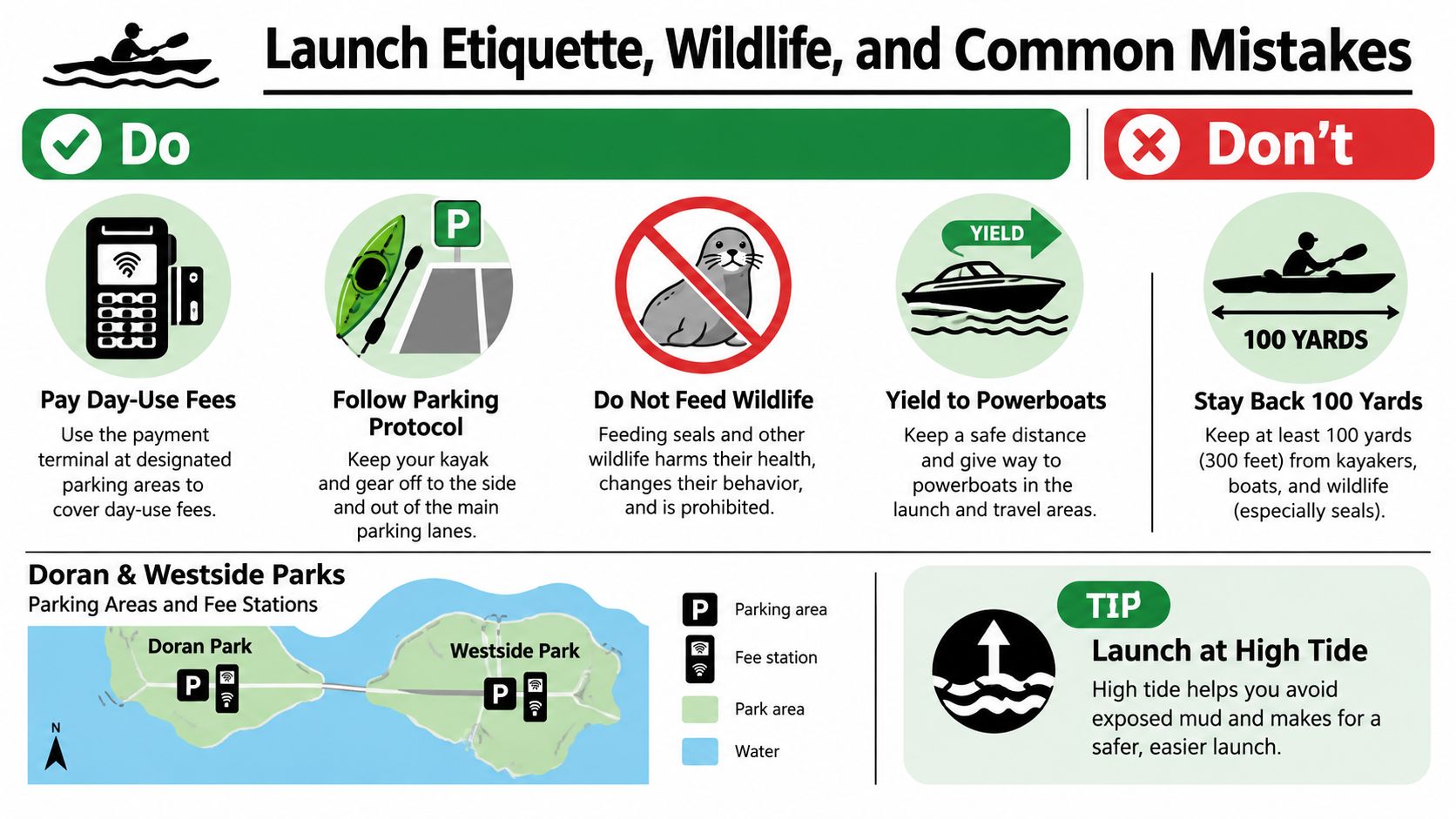
Parking mistakes start before the boat touches the water. Doran charges day-use parking unless you have the applicable pass, and the lot setup makes more sense if you decide in advance whether you are unloading quickly, parking for several hours, or managing a trailer. Families also do better when one adult handles the boat and another handles kids and loose gear, because the road, lot, and beach edge all stay busy.
Wildlife deserves more room than people think
Harbor seals, shorebirds, and roosting seabirds use the same protected corners that look inviting from a kayak. Quiet boats can get too close before paddlers realize it.
Give hauled-out seals and resting birds a wide buffer. If a seal lifts its head and tracks you, if birds start sidestepping, or if a whole group turns alert, back off and change your line. On the outer edges of the harbor, that often means accepting a less photogenic route and keeping the paddle moving.
Dogs, kids, and cameras tend to pull attention at the wrong time. The better habit is to set the boat's direction first, then look around.
Mistakes that spoil a Bodega Bay kayak day
The common errors here are usually planning mistakes with on-water consequences.
- Arriving without a launch plan. Decide before you leave Sonoma County whether you are using Doran, Westside, or another access point, so you are not debating parking, fees, and carry distance in the lot.
- Blocking the access while rigging. Load the boat, launch, and move clear. Finish small adjustments away from the main path.
- Dressing for the parking lot instead of the water. Harbor mornings can feel mild on shore while the water and breeze stay cold.
- Paddling too close to wildlife because the harbor looks calm. Protected water does not change the need for distance.
- Treating the return like an open-ended decision. Pick a turnaround time before launch, especially if your group includes children or newer paddlers.
Good etiquette is simple. Be ready before you enter the launch area, keep your group moving, and do not turn your uncertainty into everybody else's delay.
The paddlers who have the easiest day at Bodega Harbor are rarely doing anything flashy. They chose the access point on the drive over, launched with purpose, gave wildlife room, and came off the water before small problems had time to grow.

Sign up for Sonoma County Navigator
Discover Sonoma County! Latest News, places to play, stay, eat, live, shop, learn and more!
No spam. Unsubscribe anytime.